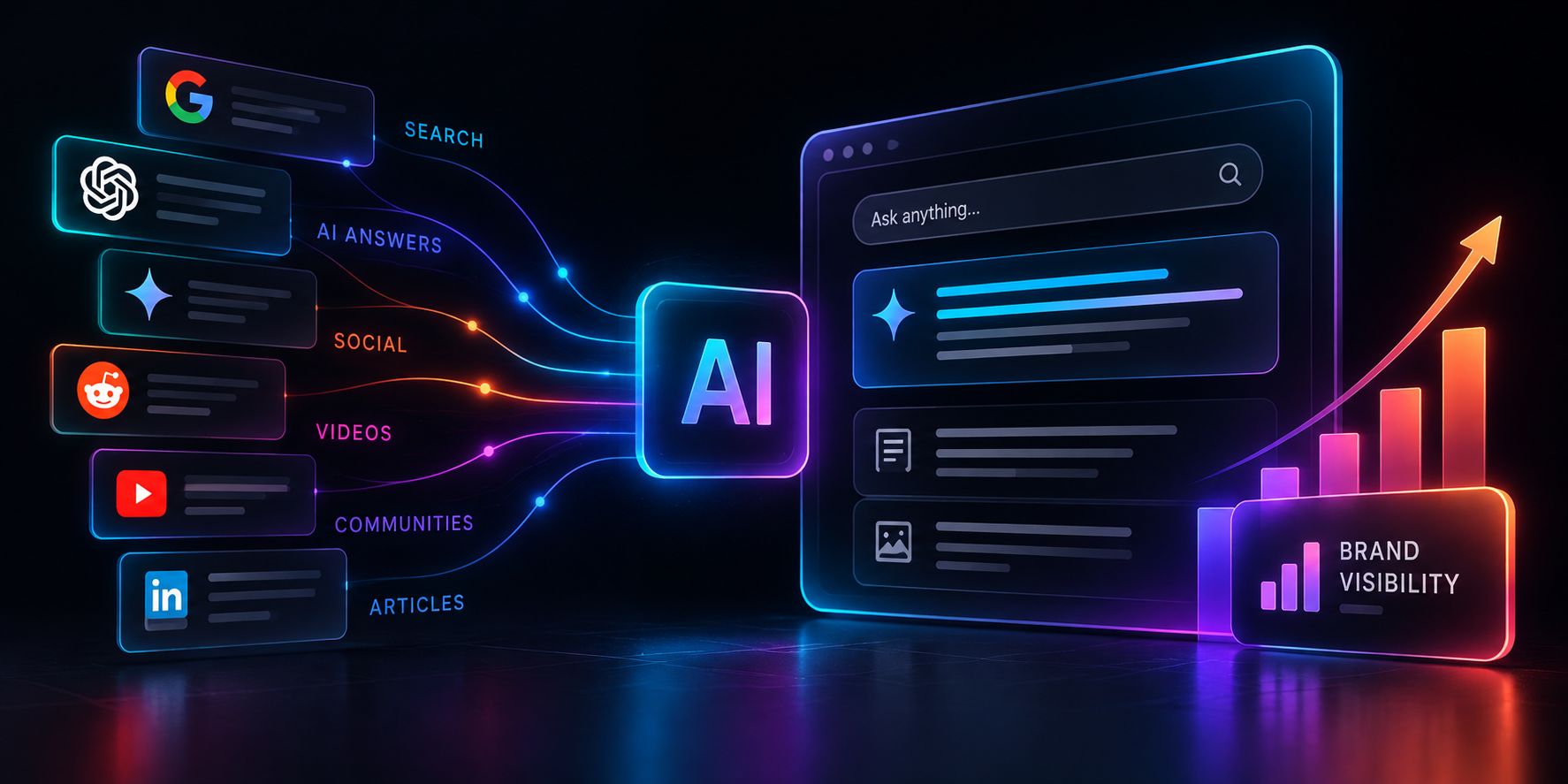
Search is changing from a simple list of links into a more conversational experience. Instead of entering a short keyword, users can now ask detailed questions, add context, compare options, and receive AI-generated answers that bring information from multiple sources together.
This shift is changing how businesses think about online visibility. Ranking on the first page of a search engine is still important, but brands also need to consider whether they are mentioned, cited, or represented accurately when people use AI-powered search.
This is where AI search visibility becomes important. It focuses on how easily a brand can be discovered and referenced within AI-generated answers, conversational search experiences, and other emerging forms of digital discovery.
How AI Is Changing Search and Discovery
Traditional search usually requires users to review several results before deciding which pages are useful. AI-powered search can reduce that process by interpreting the question, gathering relevant information, and presenting a summarized response. This shift is particularly visible in informational search: one study found that AI Overviews appeared for 98% of informational queries, compared with 40% of commercial queries and 35% of navigational queries.
This does not mean traditional search has disappeared. Instead, search and discovery are becoming more connected, with users moving between search engines, AI tools, websites, review platforms, communities, and other sources during the same decision-making process.
From Search Engines to Answer Engines
Traditional search engines primarily present a collection of webpages for a query. The user then decides which result to open and uses different sources to find the answer.
AI-driven search can work differently. Instead of simply presenting links, an answer engine can interpret the user's intent and produce a conversational response based on information it has retrieved.
For example, someone searching for "how to choose payroll software for a small business" may have previously reviewed several articles, comparison pages, and software websites. An AI search experience may instead summarize the important factors and provide several relevant sources.
This changes the discovery journey from:
Search → Browse → Compare → Decide
to a journey that can look more like:
Ask → Receive an answer → Validate → Take action
As a result, being part of the answer can become another important form of brand visibility.
The Rise of Zero-Click Discovery
Zero-click discovery occurs when a user gets enough information directly from the search experience without immediately visiting a website.
AI-generated summaries can increase this behavior because users may receive definitions, comparisons, recommendations, and explanations without opening several individual pages.
However, a zero-click interaction does not necessarily mean a brand receives no value from appearing in the answer. A business may still gain awareness when its name is mentioned or its website is cited as a source.
The challenge is that visibility is no longer measured only by website visits. Businesses increasingly need to consider where and how their brand appears throughout the discovery process.
Why Context Matters More Than Exact Keywords
AI and search are also becoming more conversational.
A user might begin with a broad question and then refine it:
"What are the best accounting software options?"
"Which ones are suitable for a small business?"
"Which has inventory management?"
"What should I consider before choosing one?"
The search experience can interpret the relationship between these questions instead of treating every query as an isolated keyword.
For businesses, this creates an opportunity to produce content that answers related questions comprehensively rather than creating separate pages around every minor keyword variation.
What AI Search Visibility Means for Brands
AI search visibility refers to how often and how accurately a business, product, service, or website appears within AI-generated search experiences.
A brand may be visible because an AI system mentions the company, recommends its service, cites its website, uses its content as a source, or includes it when answering a relevant question.
This is different from traditional rankings, where visibility is often associated with a particular position on a search results page.
From Ranking for Keywords to Being Cited for Answers
Traditional SEO asks questions such as:
Does the page rank for the target keyword?
What position does it hold?
How many impressions does it receive?
How many users click through?
AI search adds another set of questions:
Is the brand mentioned when customers ask relevant questions?
Is the brand cited as a source?
Is the information about the business accurate?
Does the brand appear for different variations of the same topic?
Which sources are being used to support the AI-generated answer?
This does not make rankings irrelevant. Strong organic visibility can still contribute to discovery and provide important signals about the quality and relevance of a website.
Instead, businesses should think of AI visibility as another layer within a broader search strategy.
What Influences Brand Visibility in AI Search?
There is no single formula that guarantees a brand will appear in an AI-generated answer. However, several fundamentals can make information easier for search systems and users to understand.
These include:
Relevant content: Pages should answer questions that are genuinely connected to the products, services, and expertise of the business.
Clear information: Important facts should be stated directly instead of being hidden behind vague marketing language.
Topical depth: A website should demonstrate useful knowledge across the subjects that matter to its audience.
Technical accessibility: Search engines and other systems need to be able to access, crawl, and interpret important website content.
Structured information: Appropriate headings, lists, tables, metadata, and structured data can help organize information.
Consistent brand information: Business names, services, locations, descriptions, and other important details should remain accurate across relevant online sources.
External authority: References from credible third-party websites can contribute to a broader understanding of a brand and its expertise.
No individual factor guarantees AI search visibility. The goal is to build a strong information ecosystem that makes a brand easier to understand and discover.
Why Third-Party Sources Can Matter
A business website is only one part of its online presence.
People and AI systems can encounter information about a company through industry publications, review websites, professional communities, news coverage, social platforms, business directories, and other third-party sources.
For example, if a company makes a particular claim about its services on its own website but important third-party sources provide outdated or conflicting information, the overall picture of the brand may become less consistent.
This is why businesses should consider their entire digital presence rather than focusing exclusively on their own website.
How Brands Can Improve AI Search Visibility
Improving AI search visibility starts with many of the same principles that make content useful for traditional search: relevance, accuracy, accessibility, clarity, and a strong understanding of user intent.
The difference is that businesses should think beyond individual keywords and consider the questions, topics, entities, and decisions surrounding their products or services.
Create Content That Directly Answers Real Questions
Start with the questions customers actually ask.
These may include:
What does a product or service do?
How much does it cost?
How does it compare with alternatives?
What are the benefits and limitations?
How does the process work?
What should customers know before buying?
Which option is appropriate for a particular situation?
Answer the core question early, then provide supporting information.
This structure makes content easier for readers to scan and can also make important information easier for search systems to identify.
Make Important Information Easy to Understand
Content does not need to be complicated to demonstrate expertise.
Use descriptive headings, short paragraphs, bullet points, comparison tables, definitions, examples, and step-by-step explanations when they genuinely improve understanding.
For example, a page explaining a technical service could begin with a straightforward definition before explaining how the service works, who needs it, what it costs, and what factors customers should consider.
Clear writing is useful for both people and machines because the meaning of the content is easier to interpret.
Strengthen Topical Authority
A single article rarely answers every question a potential customer may have.
Businesses can build stronger topical coverage by creating related content around their core subjects. A website offering a particular service, for example, might cover:
Basic definitions
How-to guides
Industry use cases
Comparisons
Common problems
Pricing considerations
Frequently asked questions
Buyer considerations
Advanced topics
These pages can then be connected through logical internal linking.
The objective is not to publish as much content as possible. It is to create a useful collection of resources that demonstrates genuine knowledge around important topics.
Improve Technical Accessibility
Good content cannot contribute to search visibility if important pages are difficult for search systems to access or understand.
Businesses should review fundamental technical elements such as:
Crawlability and indexability
Page structure
Metadata
Internal linking
Canonicalization
Mobile usability
Page performance
Structured data where relevant
Technical SEO is still important in an AI-driven search environment because search and AI systems need accessible information before they can interpret and potentially use it.
Build a Consistent Brand Presence Beyond Your Website
AI search optimization should not stop at on-site content.
Businesses should also maintain accurate information across relevant external platforms. Depending on the industry, this may include business profiles, review platforms, professional publications, industry directories, social platforms, and community discussions.
The goal is not to create artificial mentions or manipulate third-party discussions. Instead, businesses should build a genuine digital presence that reflects their expertise and provides consistent information.
AI Search Visibility vs. Traditional SEO: What Changes?
AI search visibility and traditional SEO overlap, but they are not identical.
Traditional SEO generally focuses on helping webpages appear prominently for relevant searches. AI search introduces additional opportunities for brands to be discovered through generated answers, citations, summaries, and conversational recommendations.
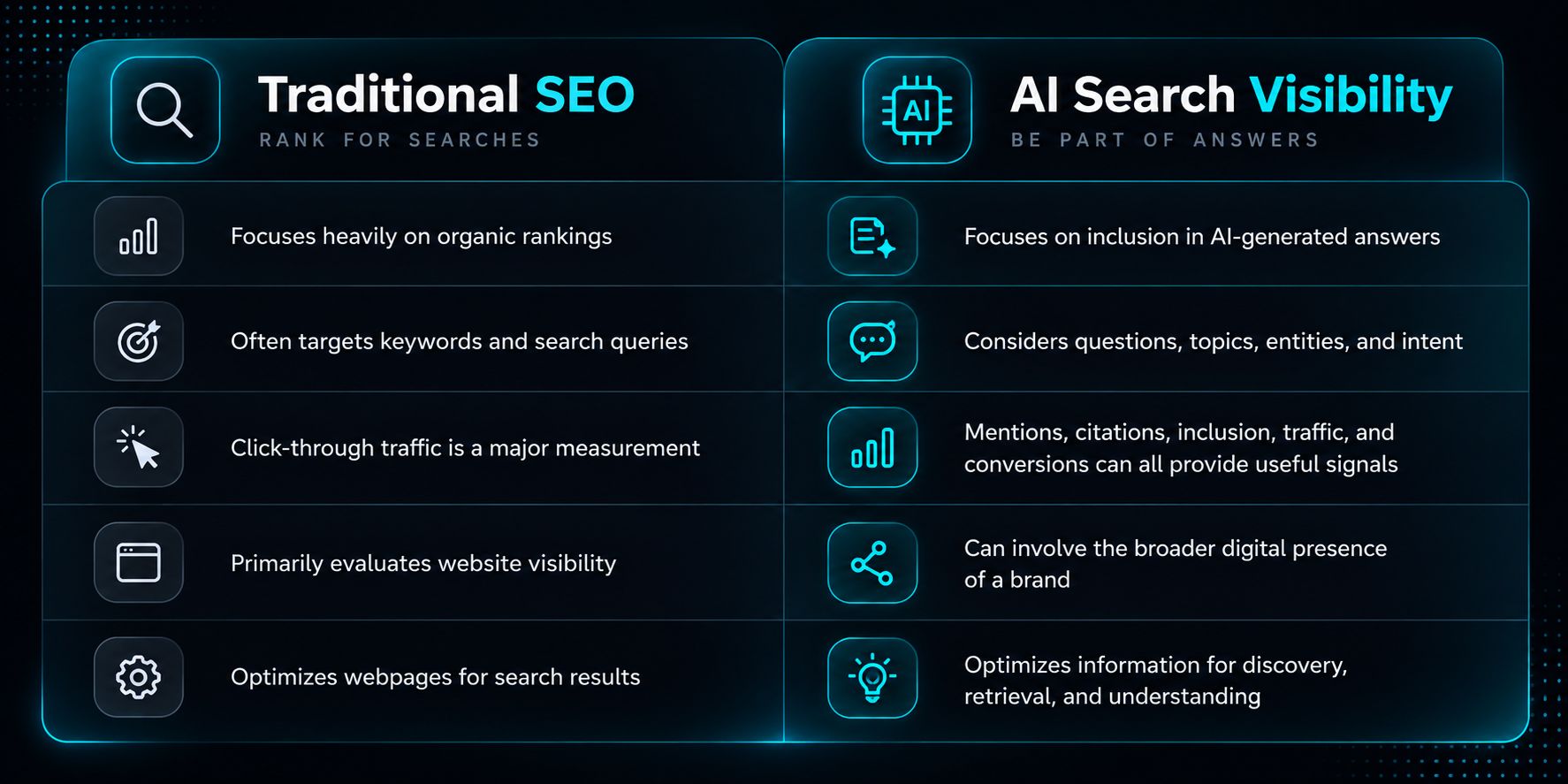
The two approaches should not be treated as competing strategies.
A technically strong website with useful, authoritative content can support both traditional organic discovery and emerging AI search experiences.
Why SEO Still Matters in an AI-First Search Environment
AI search still depends on information.
Businesses therefore need websites that are accessible, informative, well structured, and relevant to their audiences.
Traditional SEO fundamentals such as crawlability, useful content, internal linking, strong information architecture, and authoritative references remain valuable.
The bigger change is that businesses should no longer view a search result position as the only form of visibility that matters.
Where AEO and GEO Fit Into the Strategy
Two terms frequently discussed in this area are Answer Engine Optimization (AEO) and Generative Engine Optimization (GEO).
AEO generally focuses on making content useful and accessible for answer-based search experiences. GEO is commonly used to describe optimization strategies aimed at increasing a brand's visibility within generative AI responses.
Terminology can vary between platforms and marketers, so businesses should focus less on the label and more on the underlying principles.
Useful content, clear answers, strong topical coverage, technical accessibility, trustworthy information, and a consistent digital presence remain central to the broader strategy.
How to Measure AI Search Visibility and Brand Presence
Measuring AI search visibility requires looking beyond traditional rankings.
Because AI-generated answers can change based on the query, context, platform, and available sources, businesses should monitor patterns over time instead of relying on a single result.
Track Where and How Your Brand Appears
Businesses can create a set of important questions related to their products, services, and industry.
For each question, monitor whether the brand:
Appears in the answer
Is mentioned by name
Is cited as a source
Is recommended
Is compared with competitors
Is described accurately
Appears across different variations of similar questions
This creates a practical baseline for understanding current visibility.
Connect AI Visibility With Traditional SEO Data
AI visibility should also be considered alongside conventional search metrics.
Businesses can monitor:
Organic impressions
Organic clicks
Rankings
Branded searches
Referral traffic
Engagement
Leads and conversions
AI-generated brand mentions
Citation frequency
No single metric provides the complete picture.
For example, an increase in brand mentions may indicate greater awareness even if those mentions do not immediately generate website visits. Conversely, strong traffic without meaningful visibility in emerging search experiences may highlight an opportunity for future optimization.
Create an AI Search Visibility Monitoring Process
A simple monitoring process can include seven steps:
Identify important customer questions.
Test those questions across relevant AI and search experiences.
Record brand mentions and cited sources.
Identify content and information gaps.
Improve relevant website pages and supporting content.
Review the brand's wider online presence.
Repeat the process periodically and compare results.
This turns AI search monitoring into an ongoing SEO and content activity rather than a one-time experiment.
Building a Long-Term AI Search Visibility Strategy
A long-term AI search visibility strategy should connect content, technical SEO, brand authority, and measurement.
Rather than publishing content simply because a new AI-related keyword is trending, businesses should first identify where their customers are searching for information and where the brand is currently missing from those conversations.
Start With an AI Search Visibility Audit
An audit can examine:
How often the brand appears for relevant questions
Which websites are being cited instead
Important content gaps
Competitor visibility patterns
Technical accessibility
Website structure
Structured data
Third-party brand presence
Consistency of business information
The results can then be used to prioritize realistic opportunities instead of making broad changes without a clear objective.
Turn Search Insights Into a Content Strategy
Once visibility gaps are identified, businesses can create or improve content around the questions that matter most.
A strong strategy may include a mixture of:
Educational guides
Comparison content
Product or service pages
Industry resources
FAQs
Case studies
Original research
How-to content
Existing content should also be reviewed before automatically creating new pages. In many cases, improving outdated or incomplete resources can provide more value than producing another article on the same subject.
When Professional AI Search Optimization Support Can Help
Businesses managing search internally may have the resources to monitor AI visibility, conduct content research, improve technical SEO, and track changes over time.
However, professional support can be useful when a company needs a structured process across multiple areas.
This may include businesses that want to:
Understand how their brand appears in AI-generated answers
Identify important content gaps
Improve existing SEO foundations
Develop an AI search optimization strategy
Monitor brand citations and mentions
Strengthen topical authority
Connect AI visibility with broader organic search performance
The most effective approach is usually not to abandon existing SEO efforts. Instead, businesses can build on their current search strategy and adapt it to the way people increasingly discover and evaluate information.
The Future of Search and Brand Discovery
Search is becoming more conversational, contextual, and information-rich.
Users can now move between traditional search results, AI-generated answers, review platforms, communities, social networks, and brand websites during a single research journey.
For businesses, this means visibility is becoming more distributed.
A brand may be discovered through a traditional organic listing, mentioned in an AI-generated answer, referenced by a third-party publication, discussed in a community, or validated through customer reviews.
Businesses that want to remain discoverable should therefore focus on creating information that is accurate, useful, accessible, and genuinely relevant to their audiences.
The goal is not simply to appear more often. It is to build a digital presence that provides enough useful and trustworthy information for search systems, AI tools, and customers to understand what the brand offers and why it may be relevant.
FAQs About AI Search Visibility
What is AI search visibility?
AI search visibility is the ability of a brand, website, product, or service to appear or be referenced within AI-generated search answers and conversational discovery experiences. It can include brand mentions, citations, recommendations, and links to supporting sources.
How does AI affect search engine visibility?
AI can change how users consume search results by providing summarized answers instead of requiring them to visit multiple webpages. This creates additional opportunities for brands to gain visibility through mentions and citations while traditional organic rankings continue to matter.
How can a brand improve its AI search visibility?
Brands can focus on creating useful, clear, and comprehensive content; answering real customer questions; improving technical accessibility; strengthening topical authority; maintaining consistent business information; and developing a credible presence across relevant third-party sources.
Is AI search visibility replacing traditional SEO?
No. AI search introduces new forms of discovery, but traditional SEO remains important for making websites accessible and relevant to search systems. A broader search strategy can incorporate both organic SEO and AI-focused optimization.
What is the difference between AI search optimization and SEO?
Traditional SEO primarily focuses on improving visibility within search engine results. AI search optimization considers additional forms of visibility, including inclusion in AI-generated answers, citations, recommendations, and conversational search experiences.
How can businesses measure AI search visibility?
Businesses can monitor how frequently their brand is mentioned or cited for relevant questions, which sources are being referenced, how accurately the brand is represented, and how these observations relate to organic rankings, branded searches, traffic, leads, and conversions.